

Corporate Canteen Manager's Guide to Switching Away From Plastic
Switching a corporate canteen from plastic to biodegradable tableware is mostly a procurement and operations decision, not a sustainability statement. Here is how to do it without disrupting service.
Our first institutional order was a canteen in an IT campus on the outskirts of Ahmedabad — 1,400 meals a day, five days a week. The facilities manager had been told by his sustainability team to switch away from plastic. He told me on the phone he did not care about sustainability. What he cared about was plates not collapsing during lunch rush.
That call taught me more about this market than any deck I had read. Canteen managers evaluate tableware the same way a kitchen manager evaluates a new knife — does it hold up under volume, does it create a new problem, and does it fit the existing workflow. Sustainability is downstream of all three.
Corporate canteens face a specific set of constraints that event caterers do not. Volume is predictable but service pace is not. Staff are serving the same 300 to 2,000 people every working day. There is no tolerance for plate failure, and procurement decisions stay in place for months or years, not just one event.
This guide is for canteen and facilities managers doing the initial evaluation. It covers the decision factors that actually matter.
Assessing your current usage
Before evaluating alternatives, calculate your current numbers:
Daily plate and cup consumption (not procurement, actual disposal). The gap between these two numbers is your plate failure or over-ordering rate.
Annual spend on disposable tableware, broken down by category if possible.
Current disposal process: general waste, segregated waste, or composting.
These numbers set your baseline and give you the actual volume against which to evaluate alternative products.
The menu matters more than most evaluators assume
Not all canteen menus create the same demand on a plate. A dry snack canteen has completely different requirements from a South Indian thali operation or a multi-cuisine canteen serving curries and rice.
The questions to answer for your menu:
Maximum liquid volume on a plate at any point during service. This determines the moisture resistance requirement.
Time from plating to consumption. In a buffet format, a plate may sit with food on it for 5 to 15 minutes before the guest sits down. In a direct service format, the plate goes from line to table in under two minutes. The extended contact time in buffet service puts more stress on the plate.
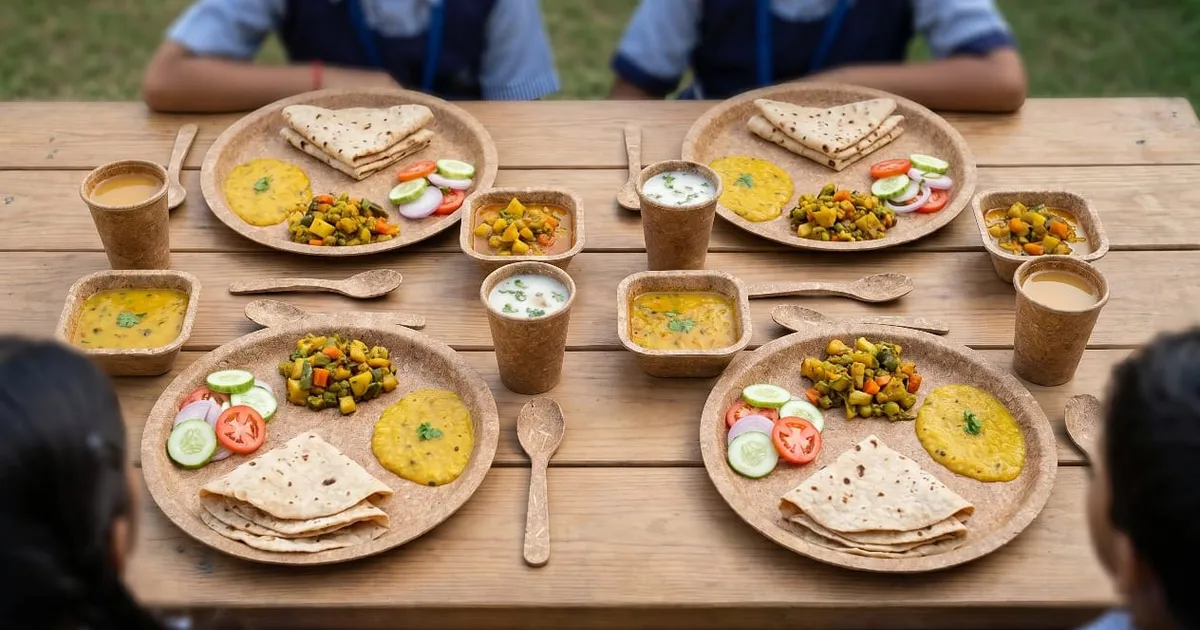
Highest heat items served. If the canteen serves food above 70 degrees Celsius on the plate (which most South Indian and North Indian food does), the plate needs to handle that without deforming.
Pulp plates work for dry menus with fast service. Rice husk composite works across most menu types. For high-volume multi-cuisine canteens, composite is the safer choice.
The trial structure that actually works
Do not pilot a switch on a random Tuesday. Structure a trial properly:
Run the alternative product in parallel with your current product for two weeks. Observe failure rates, staff feedback, and guest feedback. Track waste.
Test it on your hardest service day and your hardest menu category. If it holds up there, it will hold up everywhere. If you test it only on light days, you will not know the real performance range.
A proper two-week parallel trial with structured feedback gives you the data to make a procurement decision that will hold up for the next year or two.
Pack sizes and storage
Corporate canteen procurement typically runs on weekly or fortnightly delivery cycles. The storage capacity for consumables is usually limited. Pack sizes that are too large create storage problems. Pack sizes that are too small mean more frequent orders and higher administrative overhead.
For a 500-person canteen consuming an average of 600 plates per day (accounting for multi-course service), you need approximately 9,000 plates per two-week cycle. This is a significant storage volume. Confirm that your supplier’s standard pack sizes and pallet configurations work with your storeroom before committing to a vendor.
Waste infrastructure coordination
If your building has composting infrastructure, or if your organisation has a sustainability target around waste, the choice of tableware affects downstream waste management.
A canteen switching to certified compostable tableware can reduce the volume going to general waste, but only if the composting process exists on the output end. A compostable plate in a general waste bin still ends up in landfill.
This is worth coordinating with your facilities or sustainability team before the procurement decision, not after. The plate choice and the waste management process need to be decided together.
Supplier reliability for institutional volumes
A canteen cannot run out of plates. The supply reliability of your tableware vendor is as important as the product quality.
Questions to ask any potential supplier:
What is the lead time for a repeat order? Production to dispatch should be no more than 5 to 7 working days for standard sizes.
What is the minimum order quantity that qualifies for your institutional pricing?
What is the process if a delivery is short or delayed?
For institutional volumes, a supplier with dedicated account management for B2B clients is meaningfully different from one that processes corporate orders through a consumer-facing website.
Aura Farmers supplies directly to corporate canteens and institutional kitchens across India. For volume pricing, sample requests, and delivery timelines, contact us on WhatsApp at +91 81403 47773.