
Do Rice Husk Plates Leak? The Hot Dal and Oil Test
I left hot dal, oily sabzi and gravy on a rice husk plate for an hour. What happened, why it resists soaking, and the one case where you still want a bowl.
A caterer stopped me at a tasting in Ahmedabad last month, held up one of our plates, and asked the only question that actually matters to him: “Bhai, if I put hot dal and undhiyu on this and the guest holds it for twenty minutes in the buffet line, does it leak on his shirt?”
Fair question. So I went home, put a plate on my kitchen table, set a timer, and ran the test properly. Here is the short answer, then the honest long one.
Do rice husk plates leak? The short answer
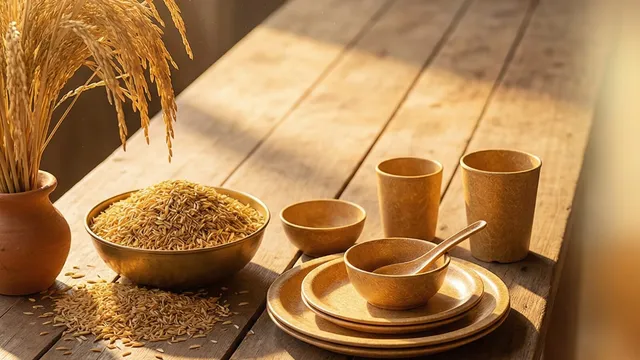
No, rice husk plates do not leak or go soggy under normal Indian food, even hot, wet, and oily food left standing through a full meal. They are highly water resistant and oil resistant. The reason is structural, not a coating: rice husk is naturally high in silica, and the plate is compression moulded at high heat with no water added, so it does not absorb liquid the way paper pulp does.
They are water resistant, not waterproof. That distinction matters, and I will show you exactly where the line sits.
The test: hot dal, oily sabzi, and a clock
I did not want a marketing test. I wanted the worst realistic case, the kind of plate a guest abandons on a table while they go talk to someone.
Three sections, one 10-inch plate:
- Hot toor dal, poured straight from the pan, still steaming.
- Oily sabzi, a proper tel-heavy aloo-methi with visible oil pooling.
- Tomato gravy, thin and bright, the kind that stains.
Then I left it. No rushing. I checked at 30 minutes and again at 60 minutes.
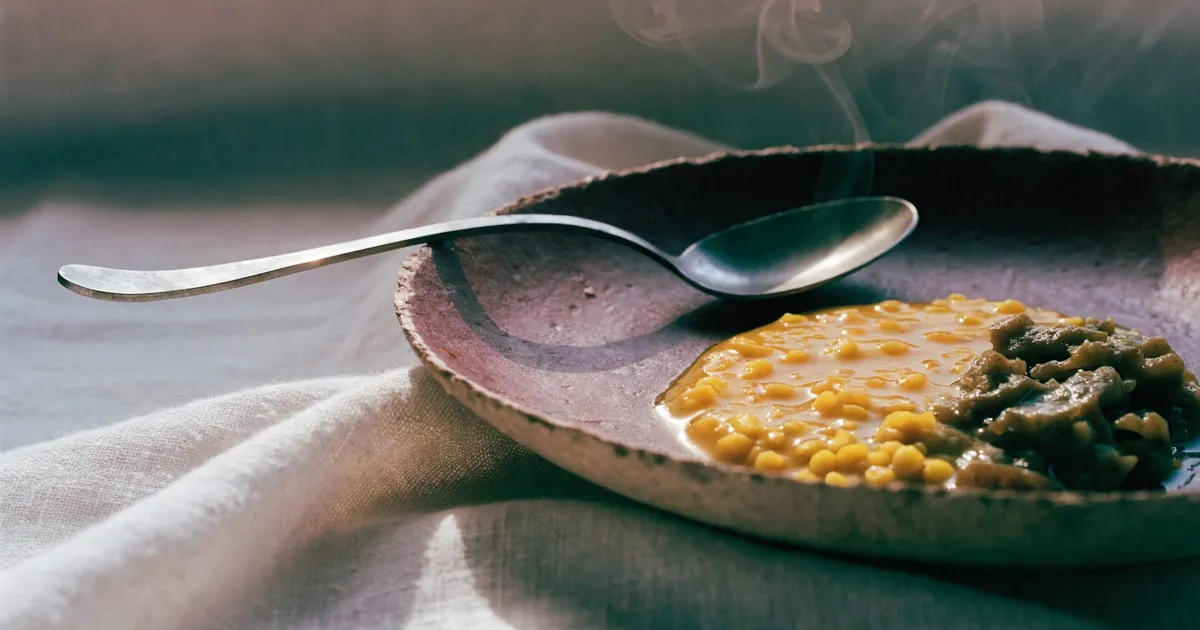
At 30 minutes: nothing. The plate was warm to the touch on the underside, which told me heat was passing through, but the base was dry. No softening, no bulge, no seepage. I could pick it up flat on my palm with no flex.
At 60 minutes: still holding. The gravy had left a faint stain on the surface, and the oily section had an oil sheen where the tel sat, exactly as it would on a steel thali. The underside was still dry. I lifted the plate by one edge with the food still on it and it stayed rigid. It did not droop in the middle, which is the classic failure you see with a wet pulp plate.
For comparison I ran the same 30 minutes on a standard moulded paper pulp plate. Under the dal it started going dark and soft at the edges within about ten minutes, and by thirty it had a wet, spongy patch you could push a finger through. That is the difference the question is really about.
Why it does not go soggy
This is not magic and it is not a plastic film. It comes from what rice husk is and how the plate is made. I wrote about the full material story in why rice husk makes better plates, but here is the part that decides the leak question.
Silica gives it a dense, non-absorbent body. Rice husk is naturally high in silica, roughly 18 to 22 percent by weight in the raw husk, per the International Rice Research Institute and multiple published materials studies. Silica is the same mineral family that makes glass hard. It does not drink water. So the raw material itself is working against absorption before we even shape it.
Compression moulding with no added water. We form the husk-and-bran mix under high pressure at around 180 to 200 degrees Celsius. No water goes into the forming process. A paper pulp plate, by contrast, is made from a wet slurry, so it starts life full of moisture and stays hungry for more. Ours comes out dense and cured, with nowhere for standing liquid to soak in.
The bran is the binder, and it is oil-friendly. Rice bran carries natural oils and proteins that bind the silica-rich husk particles together under heat. Because the binder is itself oil and protein based, oily food does not attack it or dissolve it. That is why the tel just sat on top instead of soaking through.
Here is the same food, two materials, side by side:
| What happens after 30 minutes | Paper pulp plate | Rice husk plate |
|---|---|---|
| Hot dal standing | Edges darken and soften | Stays firm and dry underneath |
| Oily sabzi | Oil begins to wick into the fibre | Oil sits on the surface, no wicking |
| Thin gravy | Can seep and weaken the base | Surface stain only, base stays dry |
| Pick it up by one edge | Droops, may tear | Stays flat and rigid |
| Microwave reheat | Steam softens it | Stays stable (see the microwave post) |
Where the plate does have a limit
I promised you the honest line, so here it is. A flat plate is not a sealed bowl, and rice husk does not change basic physics.
- Very long standing liquid. We rate the plate for a full meal, not for a puddle of thin liquid left for several hours. If dal sits alone on a flat plate overnight, any material will eventually be tested at its rim. That is not a real serving scenario, but it is the true edge.
- Deep, soupy dishes belong in a bowl. Sambar, rasam, thin kadhi, or a curry served on its own as mostly liquid should go in a bowl, not on a flat plate. Not because the plate soaks, but because a flat surface with a low rim lets liquid run over the edge when someone tilts or walks with it. This is a geometry problem, not a material one, and it applies to a steel plate too.
- It resists moisture, it is not a bag. Water resistant means it holds through the meal. It does not mean you can carry loose gravy across a hall in your hand for an hour.
None of this is a weakness in the material. It is just knowing which shape to use for which food, the same judgement you already make with steel or ceramic.
Which product for which food
The rule I give every caterer and canteen manager is simple.
Use a plate for a thali meal. When gravy, dal, or oily sabzi is one item next to rice and dry sides, which is how most Indian meals are actually eaten, a plate is exactly right. Our 10-inch round plate is built for a full meal with gravies and sides and holds it without bending or leaking.
Use a bowl for anything mostly liquid. For dal served on its own, for curries, for sweets in syrup like gulab jamun, put it in a 180 ml bowl. The deep shape keeps liquid where it belongs and nothing can run over a flat rim.
Get that pairing right and the leak question disappears. You get tableware that behaves like real tableware, stays food safe, and still decomposes in 60 to 90 days after use instead of sitting in a landfill for centuries.
That caterer, by the way, put dal-baati on our plates at a 400-guest wedding two weeks later. Nobody wore their dinner.
Sources: Silica content of raw rice husk (roughly 18 to 22 percent by weight) per the International Rice Research Institute (IRRI) Rice Knowledge Bank and multiple published materials-engineering studies. Forming temperature, compostability, shelf life, and FSSAI food-safe compliance are Aura Farmers product specifications.
Aura Farmers makes biodegradable tableware, plates, bowls, cups, and cutlery from rice husk and rice bran, no plastic and no synthetic binder. For bulk orders, reach us on WhatsApp at +91 81403 47773. Made in Ahmedabad, shipped pan-India.
Frequently Asked Questions
Are rice husk plates waterproof?
They are highly water resistant, not fully waterproof. They are compression moulded with no water added, so they do not absorb liquid the way paper pulp does. A rice husk plate holds hot, wet, oily food through a normal meal without softening, but it is not a sealed vessel for deep standing liquid over many hours.
Can I serve gravy on a rice husk plate?
Yes. A rice husk plate handles dal, oily sabzi, and gravy-based dishes without going soggy or leaking through. For deep, soupy dishes like sambar or rasam that sit as a pool of liquid, use a bowl instead of a flat plate so nothing can run over the rim.
Do biodegradable plates go soggy with hot food?
Paper pulp and leaf plates can soften under hot, wet food within minutes because they absorb moisture. Rice husk composite plates do not, because the roughly 20 percent silica in the husk plus compression moulding at high heat gives a dense structure that resists soaking. Not all biodegradable plates behave the same way.
Can rice husk plates hold oily food without leaking?
Yes. In my own test, oily sabzi and gravy left standing for an hour left an oil sheen on the surface but did not soak through or weaken the plate. There is no plastic coating doing this, the oil resistance comes from the natural silica structure of the rice husk itself.
Should I use a plate or a bowl for dal and curry?
Use a plate when dal or curry is served as one item alongside rice and dry sides, which is how most Indian thali meals are eaten. Use a bowl when the dish is mostly liquid and served on its own, so it stays contained. Both are food safe and decompose in 60 to 90 days after use.