

Most Eco-Friendly Tableware Claims Are Half True. Here Is How to Read Them.
Biodegradable. Compostable. Sustainable. These words appear on almost every product in the eco-tableware space. They do not all mean the same thing.
One of the reasons I started this company was that I kept reading product pages for “eco-friendly tableware” and could not tell, from the copy alone, what any of it was actually made of. Walk through any B2B tableware trade show or spend 20 minutes on IndiaMart and you will find a consistent set of words: biodegradable, eco-friendly, compostable, sustainable, natural. They appear on leaf plates, pulp products, bamboo items, and rice husk composites alike.
Some of these claims are accurate. Some are technically true but misleading. Some are just words. Here is a guide to reading them.
Biodegradable
This word has almost no regulatory definition in India for tableware. Technically, everything biodegrades eventually, including plastic. The question is over what timescale and under what conditions.
A product labelled biodegradable might break down in 6 months under composting conditions. It might take 5 years in a landfill. The term alone does not tell you which.
When you see “biodegradable” on a tableware product, ask for a test report showing the degradation timeline and the conditions under which that timeline was measured. Without that data, the word is decorative.
Compostable vs. industrially compostable
These are different categories and the difference matters.
Home compostable means a product breaks down in typical backyard composting conditions, which run at lower temperatures (30 to 50 degrees Celsius) and with less controlled moisture and aeration than industrial facilities.
Industrially compostable means a product breaks down at the higher temperatures and specific conditions of a commercial composting facility (55 to 70 degrees Celsius). Many products that meet industrial composting standards will not break down meaningfully in a home compost pile.
A product that is only industrially compostable has a significant limitation in the Indian context, where industrial composting infrastructure is present in fewer than 30 cities, and even in those cities, access is inconsistent.
The relevant question for any compostable tableware claim is: compostable in what conditions, and what is the expected timeline?
Bamboo products
Bamboo is a fast-growing plant and genuinely more sustainable as a raw material than virgin wood pulp. But bamboo tableware is often made with melamine resin or formaldehyde-based adhesives to hold its shape.
Melamine formaldehyde at elevated temperatures can release formaldehyde into food. The EU has limits on formaldehyde migration from bamboo products into food. India does not have equivalent regulations yet.
The bamboo itself may be sustainable. The binder holding it together may not be. Ask for migration test data specifically for formaldehyde if you are procuring bamboo tableware for food service use.
Sugarcane bagasse (pulp)
Bagasse is the fibre left after extracting juice from sugarcane. It is genuine agricultural waste, similar to rice husk in its origin story, and bagasse pulp products are one of the more common eco-friendly tableware formats in India.
The structural limits are real: bagasse pulp absorbs water over time, which is why you see plates softening under liquid food. The structural performance is a material constraint, not a manufacturing defect.
The more relevant issue is bleaching. Most commercially available bagasse pulp products are bleached white using chlorine-based processes. The bleaching produces dioxins as a by-product. Some manufacturers use oxygen bleaching (TCF, totally chlorine free) as an alternative. The unbleached, natural-brown bagasse products avoid this entirely.
If the pulp product you are buying is pure white, ask about the bleaching process.
What honest claims look like
A product making credible environmental claims should be able to provide:
- The specific raw material and its source
- A test report showing degradation timeline and conditions
- A food contact safety certification with specific migration test data
- No synthetic binders, coatings, or bleaching agents, or full disclosure if any are present
This is not a high bar. It is documentation of what you already claim to be true. If a supplier cannot produce it, the claim is marketing copy, not a verified fact.
What we will and will not claim about our own products
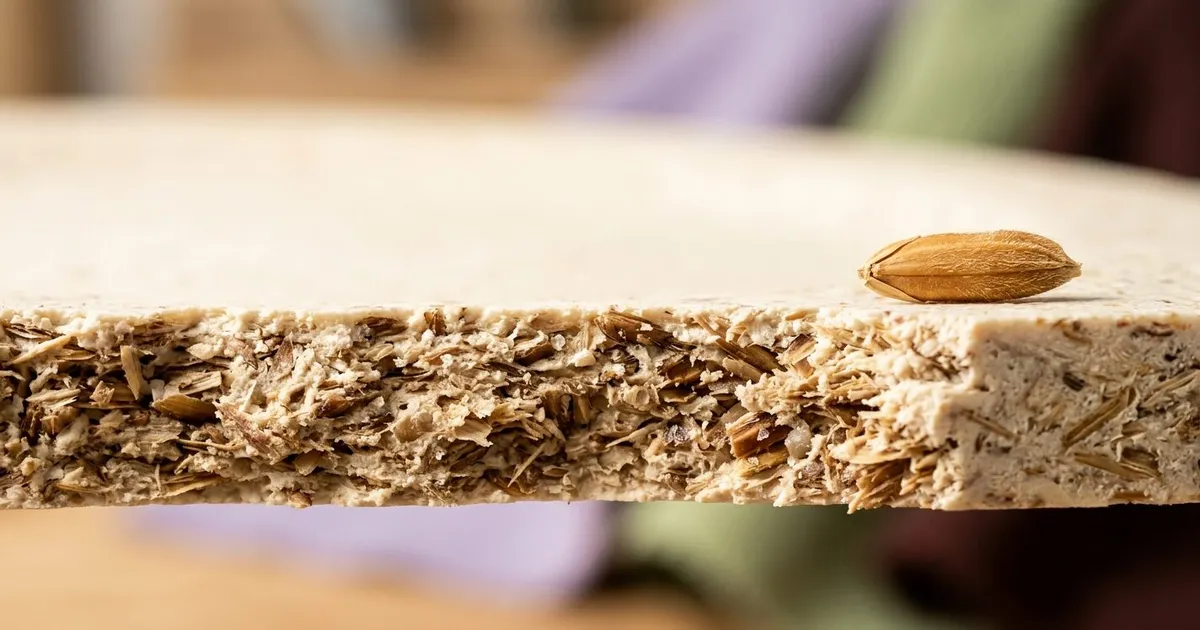
Aura Farmers plates are made from rice husk and rice bran with no synthetic binders. The natural oils in rice bran act as the binding agent under compression moulding. We do not bleach, coat, or add plastic films. Our food contact safety certification covers migration limits for heavy metals and restricted substances.
I will not claim our manufacturing is carbon neutral or zero-impact. It is not. We run a factory, we use energy, we transport goods across the country. What I will claim is that the material inputs are genuine agricultural waste, the finished product is food-safe, and it degrades in composting conditions within 60 to 90 days.
That is the scope of what we can verify. It is enough for a meaningful choice, and it is honest. Everything beyond that, from us or from a competitor, deserves the same scrutiny this post asks you to apply.
Have questions about our product composition or certifications? Reach us at info@aurafarmers.in.