
Feeding Lakhs at Rath Yatra: Compostable Prasad Plates
Rath Yatra feeds lakhs in a day and leaves a mountain of thermocol behind. The case for compostable rice husk prasad plates for Ahmedabad's mandals.
The morning after last year’s Rath Yatra, I walked from Saraspur toward Kalupur while the city was still half asleep. The chariots were gone, the crowds were gone, and what was left underfoot was thermocol. Crushed white dishes, flattened cups, a slick of leftover mag and jamun over all of it, and sanitation crews working through the mess in the heat. Lakhs of people had been fed with real devotion the day before. What they left behind will outlast most of us.
Ahmedabad’s Rath Yatra rolls out again on 16 July this year, on Ashadhi Beej. It is often described as India’s second-largest chariot procession after Puri’s, and the 2026 edition is the 149th. It starts from the 400-year-old Jagannath temple at Jamalpur and winds through the old city, Jamalpur, Khadia, Kalupur, and Saraspur, for the better part of a day. Along that route, temple kitchens, community bhandaras, and mandal stalls feed lakhs of devotees free of cost. That is the annakshetra spirit at the heart of the day. The case for compostable rice husk prasad plates in Ahmedabad is simply this: at that scale, the plate you serve on decides whether you leave behind soil or landfill. A rice husk plate composts in 60 to 90 days. A thermocol dish never really goes away.
How much waste does a mega mahaprasad actually create?
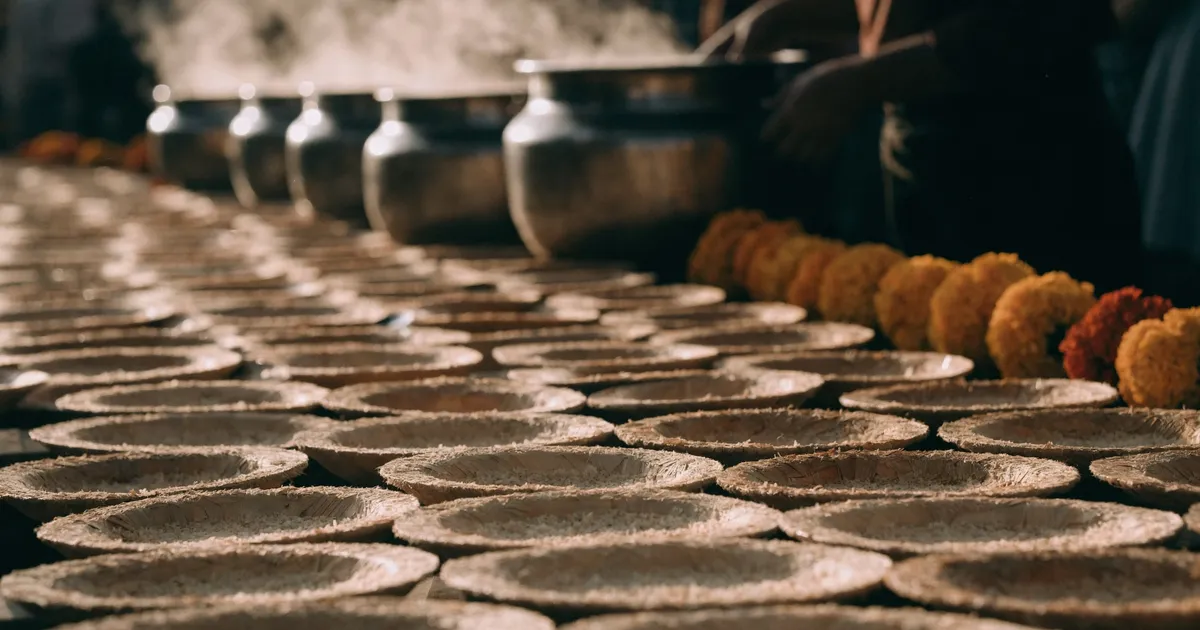
Nobody hands out a single plate at Rath Yatra. A busy mandal stall serves from dawn to dusk, and one such stall can move through tens of thousands of plates and cups in a day. Multiply that across dozens of stalls, temple annakshetras, and bhandaras along an old-city route, and the tableware waste from one day of feeding runs into the tonnes.
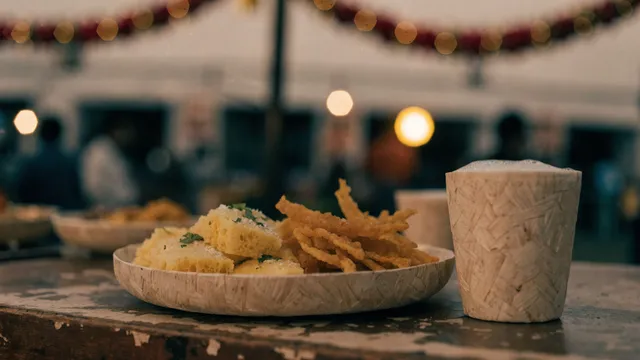
Here is the part people miss. Food waste is compostable. Thermocol is not. When the two get mixed in the same bin, and at a mega event they always do, the whole heap becomes landfill. Serve mahaprasad on thermocol and you have turned a plate of prasad into permanent waste. Serve it on a rice husk plate and the plate, the scrapings, and the leftover food all go to the same compost stream together.
Thermocol, which is expanded polystyrene, has been banned under India’s single-use plastic rules since 2022. It is still seen at large gatherings because it is cheap and enforcement is uneven, but it is illegal, it does not biodegrade, and municipal drives during festival season increasingly catch it out.
Why compostable plates fit a one-day mass-feeding operation
A festival mahaprasad is a brutal test for any plate. The food is often wet, mag, dal, khichdi, shiro, sometimes served hot, and it sits on the plate while the devotee stands in a moving crowd. Three things matter, and rice husk plates handle all three.
- They hold wet food. Rice husk is roughly 20 percent silica by weight, which makes the plate rigid. It is moulded with heat and pressure at around 180 to 200 degrees Celsius with no water added, so it resists moisture rather than drinking it up. A thin paper or pulp plate softens in 15 to 20 minutes under gravy. A rice husk plate does not.
- They are safe for hot prasad. Our plates are FSSAI food-safe compliant and carry no plastic or wax coating, so there is nothing to leach into hot food. The plate is made of rice husk and rice bran, with the bran acting as the natural binder. No synthetic glue.
- They close the loop the same day. After the meal, the plate and the food scraps are one waste stream, not two. That is the single biggest operational advantage at an event where separating waste by hand across lakhs of people is impossible.
For the standard mahaprasad thali, a sturdy 10 inch plate does most of the work. You can see the one we make on the 10-inch plate page.
The bulk supply problem, and how to solve it
The hard part of a mega event is not the idea. It is the logistics of getting lakhs of plates to the right stalls on one specific morning.
Festival demand behaves like wedding demand: it is spiky, concentrated, and everyone wants the same thing in the same week. We have written about that pattern in detail in our note on Indian wedding demand, and Rath Yatra is the same shape, just compressed into a single date. The lesson carries over directly.
- Estimate against footfall, then add a buffer. Base your quantity on how many people your stall or kitchen actually served last year, not a hopeful guess. Add 15 to 20 percent for the day that runs long.
- Order two to three weeks ahead. The whole quantity is needed on 16 July, all at once. Nobody can mould lakhs of plates in 48 hours during festival week. Locking your order early is how you guarantee the stock exists.
- Coordinate as a group. If several mandals or a temple trust pool their requirement into one large order of a single plate size, it is far easier to allocate and deliver than a dozen scattered small orders, and it usually gets you better pricing.
- Split the order by course. Use the sturdy rice husk plate for the wet main mahaprasad, and keep lighter items, a single ladoo or a scoop of dry prasad, on a smaller plate or wrap. Smart procurement beats brand loyalty.
We are based in Ahmedabad, so for Rath Yatra orders the plates do not travel far. Same-city delivery removes much of the risk that comes with shipping bulk stock across the country during a festival rush.
What happens to the plates after? The disposal question.
This is the part that separates a real green switch from a feel-good gesture. A compostable plate that ends up in a landfill still breaks down eventually, but not in the 60 to 90 day window that active composting gives you, and the environmental point is mostly lost. The plate is only as good as the disposal chain behind it.
For an event this size, the practical path is:
- Source separation at the stall. Two clearly labelled bins at every stall: one for food and plates together, one for everything else. Keep it that simple. More categories create more confusion at scale. We covered the how-to in our event composting guide.
- A named person per stall watching the bins. Signage alone does not work in a moving festival crowd. One volunteer redirecting waste at each stall does more than any poster.
- A processor lined up in advance. Ahmedabad has organic waste collectors and composting operators, and the Ahmedabad Municipal Corporation runs its own sanitation during the yatra. Tie up with an approved processor, or a farm that will take the food-and-plate stream, before the day, not after.
Get that chain right and the day ends with tonnes of material heading to compost instead of landfill. That is the whole point.
Where this does not work yet
I would rather be honest than oversell, so here is the trade-off.
Cost. A rice husk plate costs more per piece than a thermocol dish. At lakhs of plates that gap is real money, and for a small mandal running purely on donations it is a genuine constraint. What it buys you is legality, a plate that does not fail mid-service, and waste that composts. Thermocol saves money on the day and passes the cost to the city the next morning.
Disposal has to be arranged, or the benefit shrinks. If your used plates go into the general municipal heap with no separation, you have paid for a better plate and gotten a fraction of the value. Compostable tableware without a composting plan is half a solution.
Single-item handouts. If a stall gives out one dry ladoo or a spoon of prasad per person, a full plate is more than the job needs, and a small paper wrap or leaf donna may be cheaper. Rice husk plates earn their place at the full mahaprasad thali, not every counter.
Here is the honest comparison for festival mahaprasad service:
| For mahaprasad service | Thermocol | Paper or pulp plate | Rice husk plate |
|---|---|---|---|
| Legal under the plastic ban | No | Yes | Yes |
| Holds wet food, dal, khichdi | Yes, but non-compostable | Softens in 15 to 20 min | Holds shape |
| After use | Landfill, never breaks down | Composts if uncoated | Composts in 60 to 90 days |
| Cost per piece | Lowest | Low | Higher |
Rath Yatra is Ahmedabad at its most generous, a whole city feeding strangers for a day. The one thing worth fixing is the trail it leaves. The plate is a small decision that scales into a very large pile, and choosing one that goes back to the soil instead of sitting in it forever feels like the right way to serve prasad. If you run a temple kitchen, a bhandara, or a mandal stall and want to plan your Rath Yatra tableware, reach out and we will help you size the order.
Sources: the 2026 Ahmedabad Rath Yatra date (16 July, Ashadhi Beej) and 149th edition are per Republic World, Akashvani News (newsonair.gov.in), and Incredible India; procession history since 1878 per Wikipedia. Crowd size is kept qualitative (“lakhs of devotees”) as widely reported. India’s single-use plastic ban on thermocol has been in effect since 1 July 2022.
Aura Farmers makes biodegradable tableware, plates, bowls, cups, and cutlery from rice husk and rice bran. For bulk Rath Yatra and event orders, reach us on WhatsApp at +91 81403 47773. Made in Ahmedabad, shipped pan-India.
Frequently Asked Questions
Are compostable plates good for temple prasad distribution?
Yes. Rice husk plates hold their shape under wet mahaprasad like dal, khichdi, and shiro, they are FSSAI food-safe, and they carry no plastic coating that could leach into hot food. For a one-day feeding of large crowds they behave like a proper plate, not a soggy sheet, which is where thin paper and pulp usually fail.
How are used compostable plates disposed of after a big event like Rath Yatra?
They go into a source-separated food-and-plates stream, not the general bin, and then to a composting site or an approved organic waste processor. Rice husk plates break down in about 60 to 90 days when actively composted. If they end up mixed into landfill waste the composting benefit is largely lost, so arranging the disposal chain beforehand is as important as choosing the plate.
How many compostable plates does a mass-feeding event need, and how far ahead should we order?
A single busy mahaprasad stall can go through tens of thousands of plates in a day, so estimate against your expected footfall and add a buffer. Because the whole quantity is needed on one date, order two to three weeks ahead. No honest supplier can produce lakhs of plates on 48 hours notice during a festival week.
Do rice husk plates hold up to wet mahaprasad like dal, khichdi, or shiro?
Yes. Rice husk is about 20 percent silica by weight, which gives the plate rigidity, and it is moulded with heat and pressure with no water added, so it resists moisture instead of softening. It holds a full wet thali without collapsing, unlike untreated paper or pulp plates that soften in 15 to 20 minutes.
Are compostable prasad plates more expensive than thermocol at scale?
Per piece, yes, a rice husk plate costs more than banned thermocol. But thermocol is illegal under India's single-use plastic ban, carries fine risk during municipal drives, and never breaks down. When you count fines, cleanup, and disposal, the real cost gap at event scale is smaller than the sticker price suggests.